Books
GST invoicing, double-entry accounting, inventory across warehouses, counter sales and quotations. For a business whose first problem is getting its books right.
Business software for India
Books, people, sales and projects in one system. GST-native, and priced for the whole company rather than per user.
Free plan, no card. Paid plans include a 14-day trial.
The product
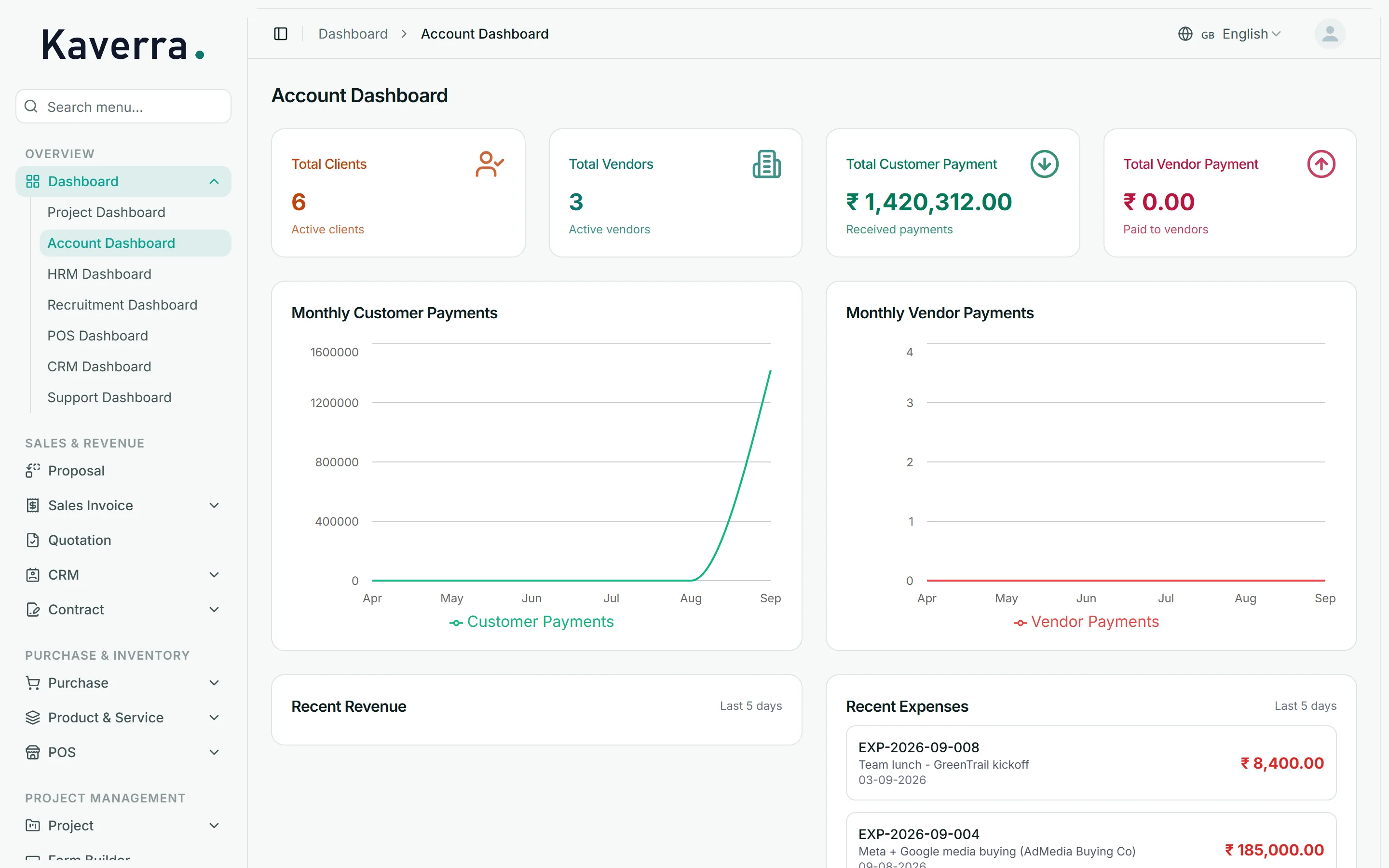
One login. The invoice you raised on Friday is already in the books, the tax split is already decided, and payroll is a button.
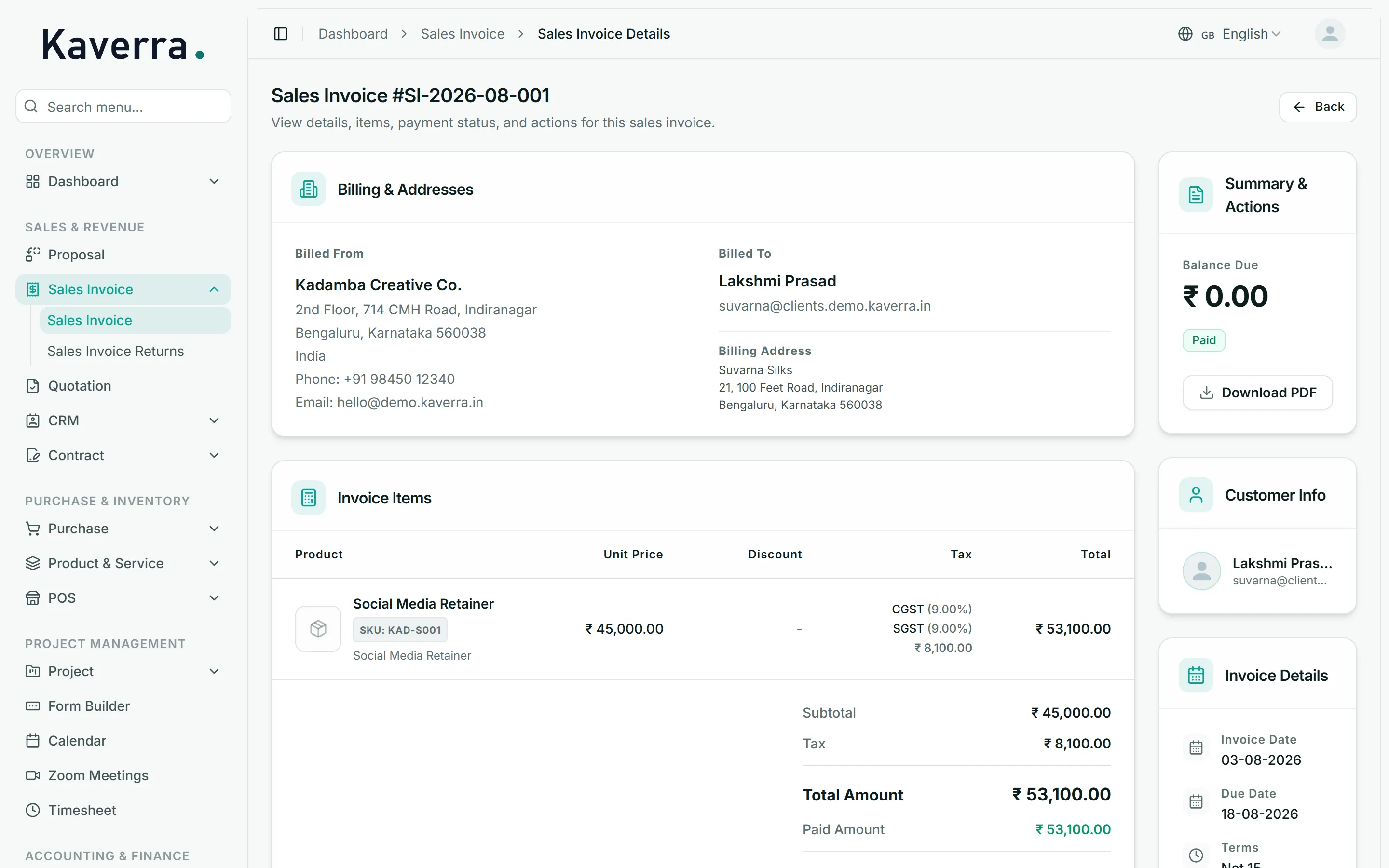
Raise a GST invoice and the ledger, receivables and GSTR-1 move together. Nothing to reconcile later.
Your state against the customer's — CGST + SGST or IGST — chosen by the system, not the typist.
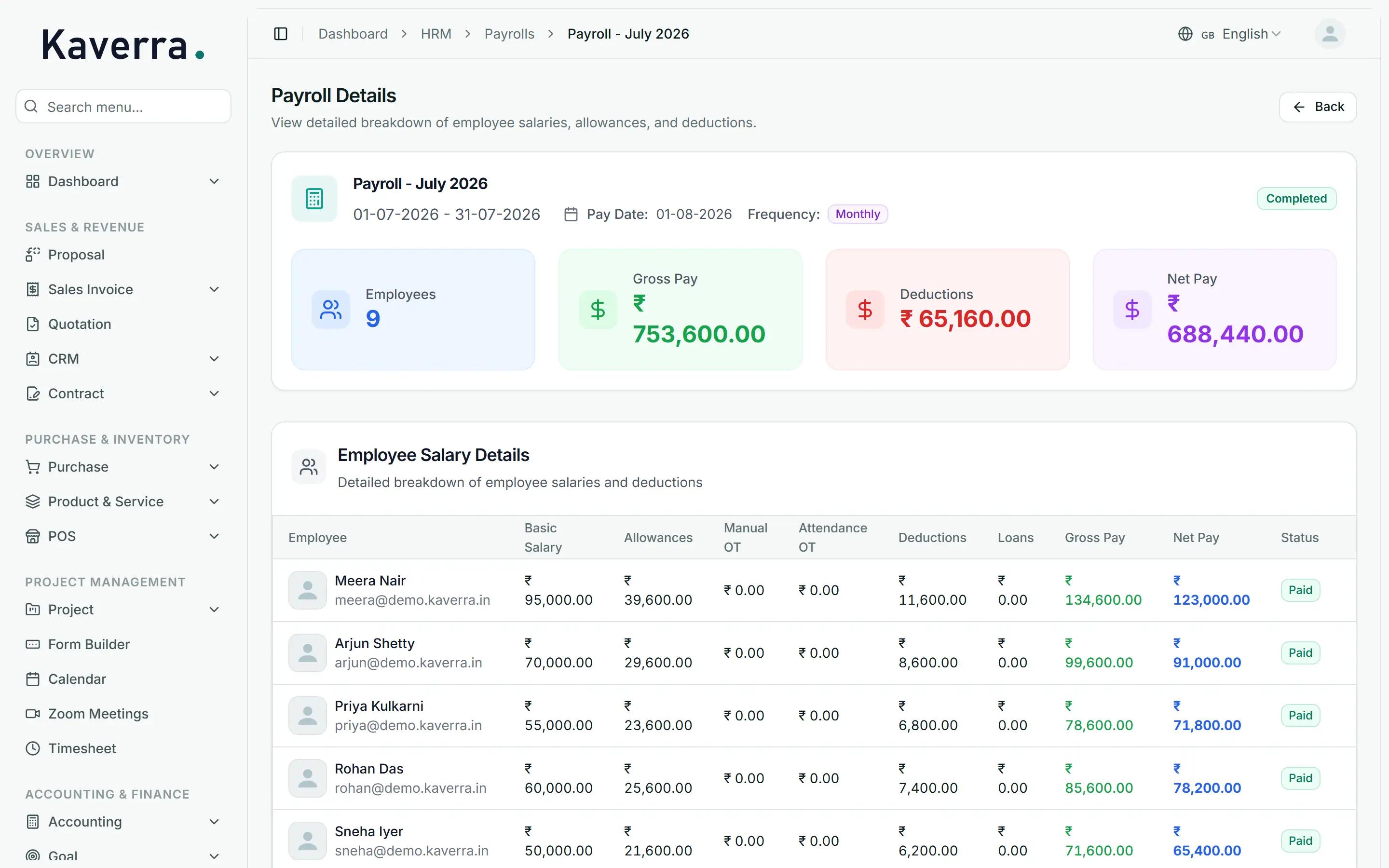
Attendance in, payslips out, salary posted to the ledger. One run, no spreadsheet.
The arithmetic
Most business software charges for every person you add. So the software gets more expensive precisely when you hire — and teams start sharing logins to keep the bill down, which is how an audit trail stops meaning anything.
₹580 is illustrative of typical per-user list pricing for mid-tier business suites. Actual rates vary by vendor, plan and contract term.
Or ₹29,999 paid yearly — two months free. All figures exclude 18% GST.
a year — and every hire after that costs nothing in licence fees until you outgrow the band.
Buy what you need
Most suites sell one bundle and let you pay for the parts you'll never open. Kaverra splits along the line businesses actually divide on — the books, or the people — and joins them again when you need both.
GST invoicing, double-entry accounting, inventory across warehouses, counter sales and quotations. For a business whose first problem is getting its books right.
Attendance, leave, payroll posting to the ledger, hiring with a public careers page, appraisals and timesheets. For a business whose first problem is its staff.
Both, plus CRM, projects, contracts, support desk and the integrations. One system, one login, one bill — for up to 50 people.
Built for how Indian businesses actually file
Place of supply decides the split, the product decides the rate, and the server decides both — never the browser. Raise an invoice and the return is already taking shape.
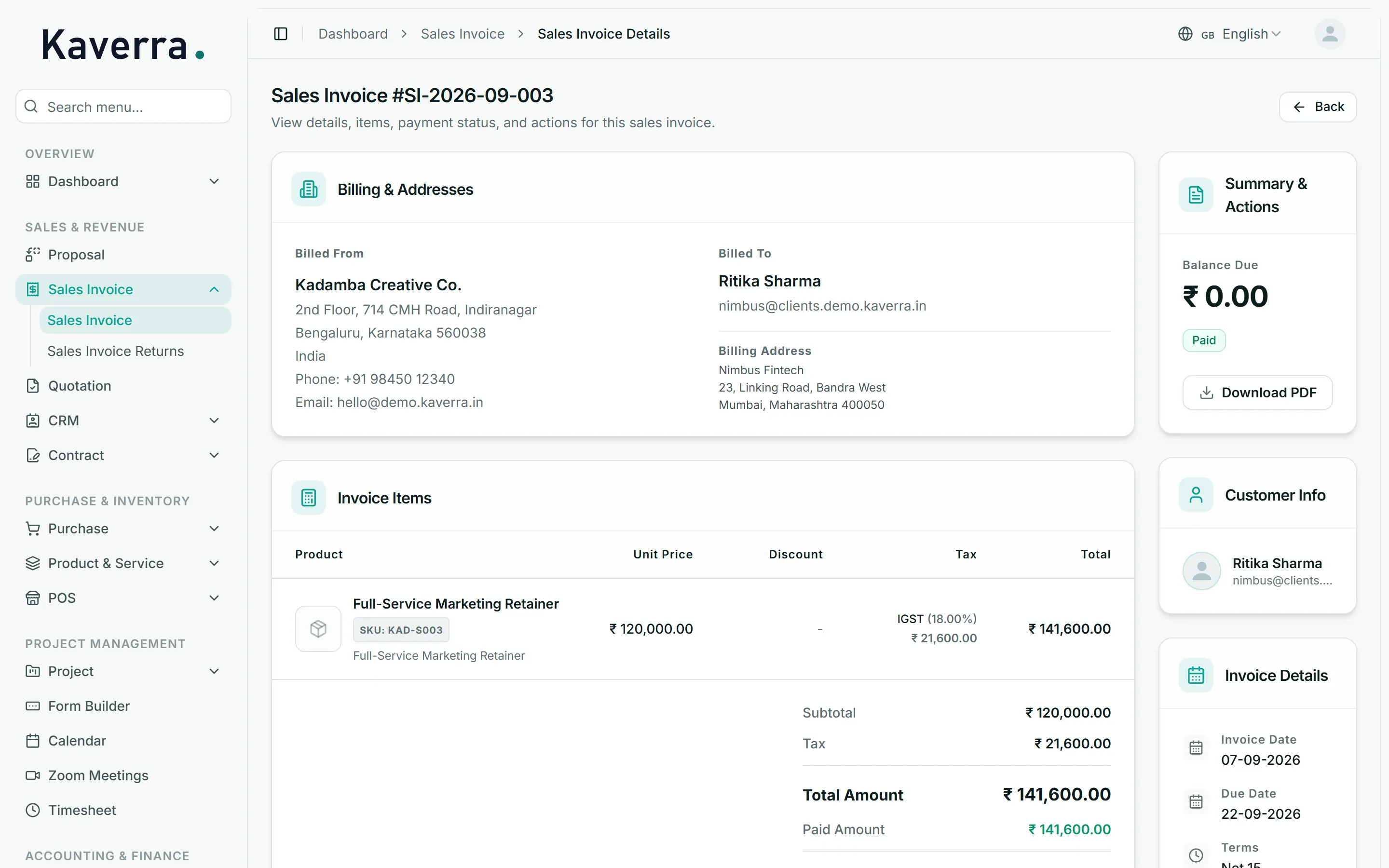
Same state as yours and the tax splits in two at half the headline rate. Different state and it's a single IGST line. Decided from the customer's place of supply on every document, not from a dropdown someone remembers to change.
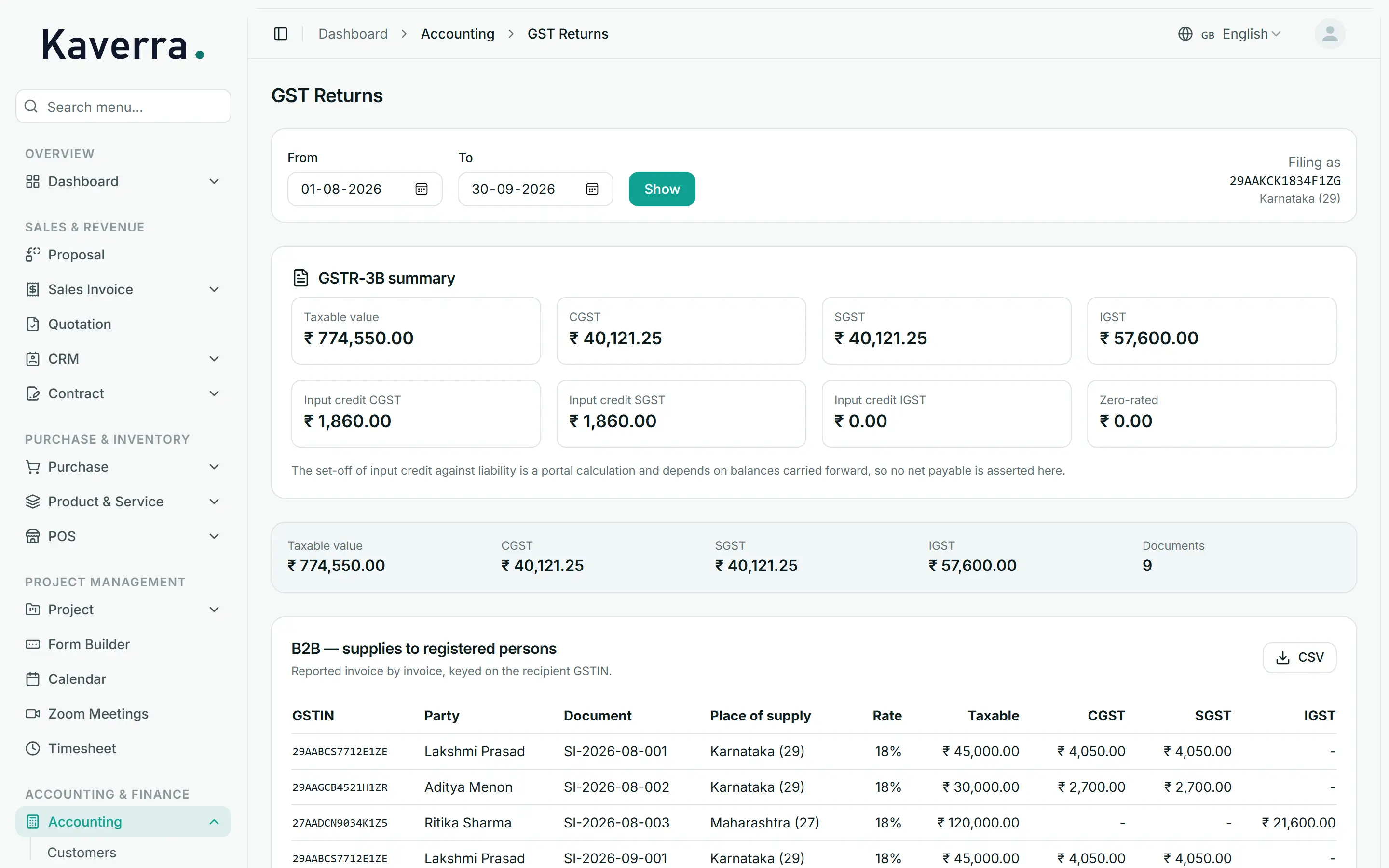
B2B, B2CL, B2CS, CDNR, EXP, HSN and DOCS, each downloadable as CSV. Anything that couldn't be classified is named on screen with its amount and the reason — before it quietly becomes a mismatch.
E-invoicing (IRN and QR), e-way bills, direct portal filing and GSTR-2B matching are not built. The software produces the figures; a qualified professional files the return. If your turnover puts you above the e-invoicing threshold, tell us before you buy — the full picture is here.
Full database restore, rehearsed and timed — not assumed.
Pulled off-site daily; a truncated dump never replaces a good one.
Every record carries its company and is filtered on the way out of the database.
Two users, the books modules, no card. Move up when it earns its place.
What's inside
Every module writes to the same ledger and the same customer list. A POS sale, a payroll run and a project invoice all land in the books without anyone re-keying them.
Modules are entitlements, not installations. Everything is already on the server — moving up a plan turns modules on for your company immediately, and your data is untouched either way. Nothing to install, no migration, no downtime.
Start free, or take a 14-day trial on any paid plan.
Pricing
Pick the band that fits your headcount, then add people up to it without the bill moving. All prices exclude 18% GST.
The books modules for two people, so you can see whether it fits before paying anything.
GST invoicing, accounting, inventory and counter sales. For a business that needs its books right.
Attendance, leave, hiring, appraisals and timesheets. For a business whose priority is its staff.
Every module. Books, people, CRM, projects and support in one system.
Everything, for a larger team, with priority support and a longer trial.
| Free | Books | People | Complete | Enterprise | |
|---|---|---|---|---|---|
| Limits | |||||
| Users included | 2 | 10 | 25 | 25 | 100 |
| Storage | 1 GB | 10 GB | 25 GB | 50 GB | 100 GB |
| Free trial | — | 14 days | 14 days | 14 days | 30 days |
| Money | |||||
| GST invoicing & tax invoice PDF | ✓ | ✓ | — | ✓ | ✓ |
| Accounting & double entry | ✓ | ✓ | — | ✓ | ✓ |
| GSTR-1 & GSTR-3B with CSV | ✓ | ✓ | — | ✓ | ✓ |
| Inventory & warehouses | ✓ | ✓ | — | ✓ | ✓ |
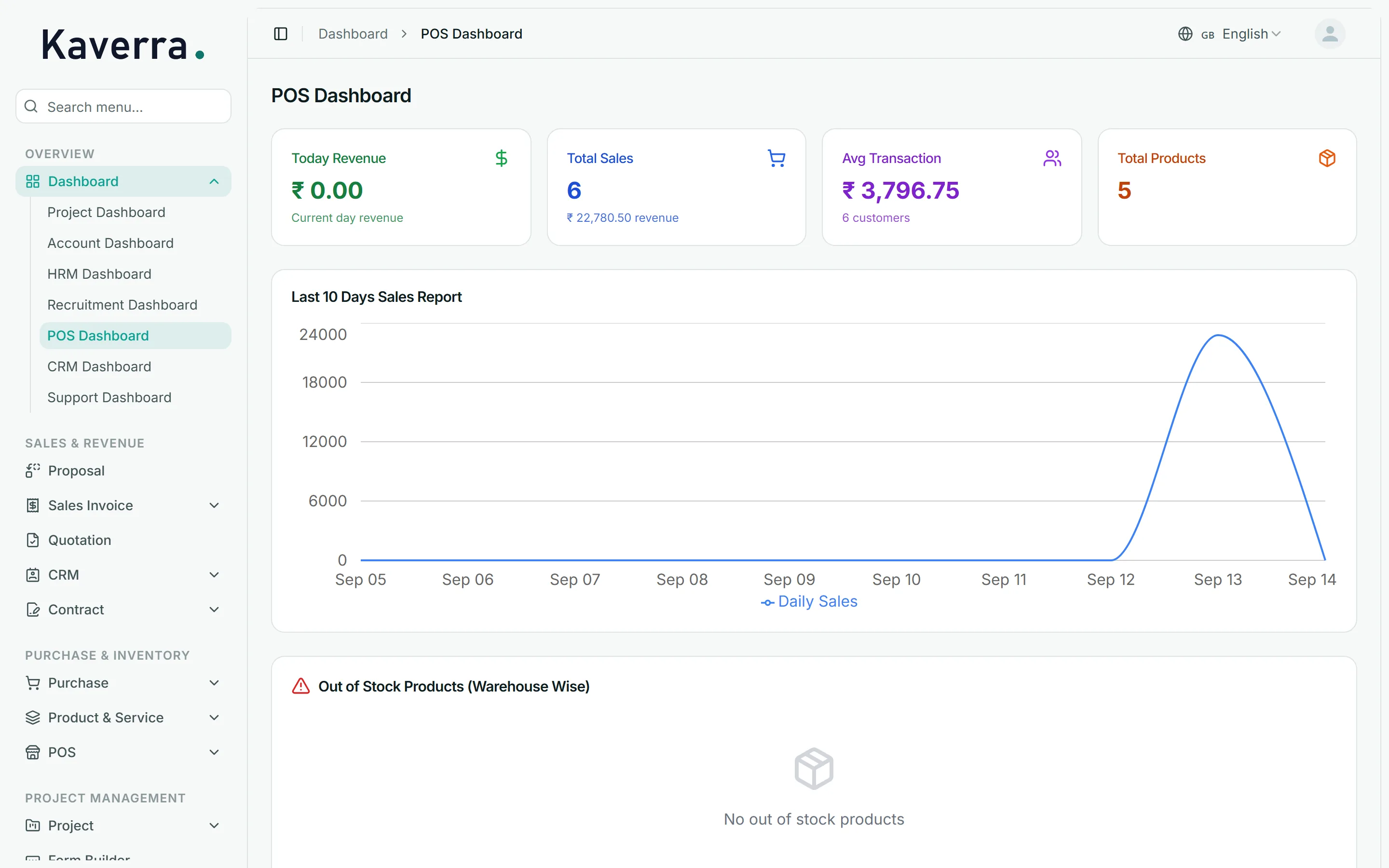
| Point of sale | ✓ | ✓ | — | ✓ | ✓ |
| Budgets & financial goals | — | — | — | ✓ | ✓ |
| People | |||||
| HR, attendance & leave | — | — | ✓ | ✓ | ✓ |
| Payroll posting to the ledger | — | — | ✓ | ✓ | ✓ |
| Recruitment & careers page | — | — | ✓ | ✓ | ✓ |
| Appraisals, training, timesheets | — | — | ✓ | ✓ | ✓ |
| Customers & work | |||||
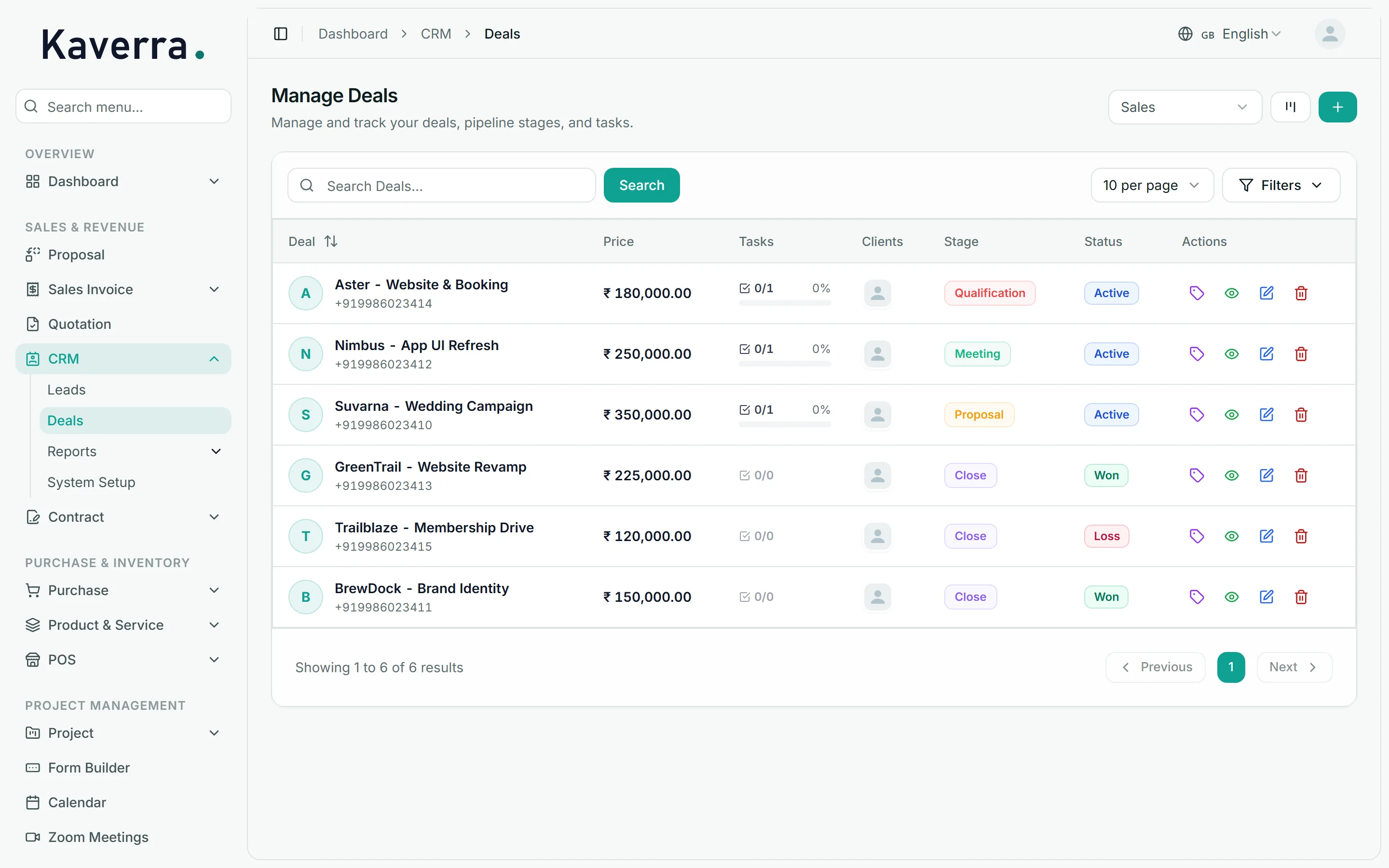
| CRM — leads & deals | — | — | — | ✓ | ✓ |
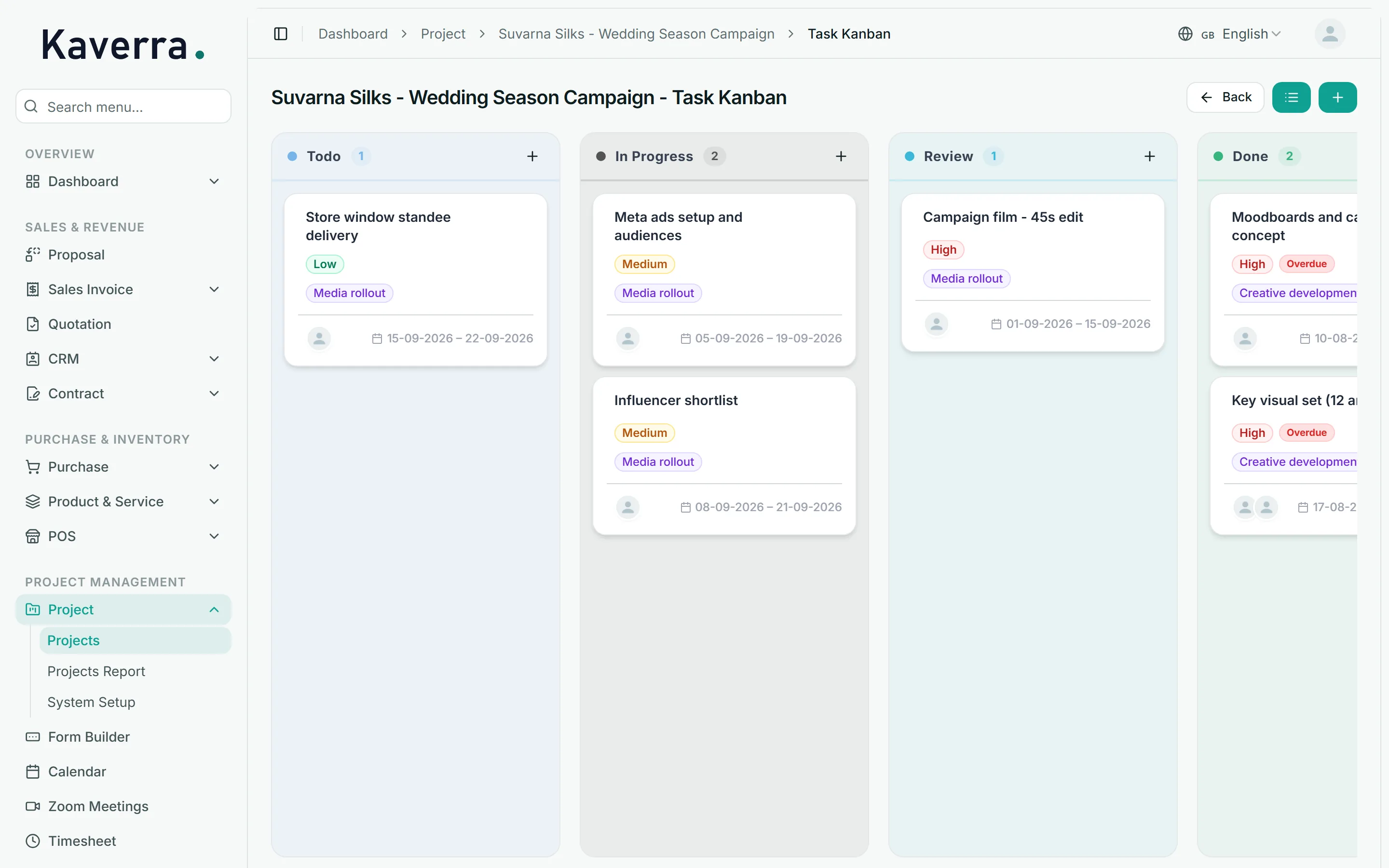
| Projects, tasks & milestones | — | — | — | ✓ | ✓ |
| Support desk & knowledge base | — | — | — | ✓ | ✓ |
| Contracts & form builder | — | — | — | ✓ | ✓ |
| Slack, Telegram, Twilio, webhooks | — | — | — | ✓ | ✓ |
| Running it | |||||
| Nightly backups, held off-site | ✓ | ✓ | ✓ | ✓ | ✓ |
| Priority support | — | — | — | — | ✓ |
| Guided setup & data import | — | Paid | Paid | Paid | Included |
A user is a person with their own login, which is how the audit trail stays worth something. If you outgrow a band, move up a plan — your data is untouched and access changes the moment the plan does.
Module access stops and your data stays exactly where it is. Nothing is deleted, and renewing restores access immediately.
Yes, in either direction, and it takes effect at once. Moving up turns modules on for everyone in your company; moving down turns them off but leaves the records in place.
Card, UPI, net banking and wallets through Razorpay. Yearly plans are invoiced with GST and a SAC code, so your accountant can claim the input credit.
Yes. Every record carries its company and is filtered on the way out of the database. The security page explains how that is enforced and where its limits are.
Yes — a paid setup that covers your chart of accounts, tax rates, product catalogue with HSN codes, opening stock and staff accounts. It's included on Enterprise. Setting these up in the right order matters more than it looks, so most companies take it.
GST
Most GST problems are made months before the return — a wrong state on a customer, a missing HSN code, a rate typed by hand. Kaverra decides those on the server, from your master data, on every document.
Your company's state against the customer's decides the split — two components at half the rate within the state, one IGST line across states. Nobody has to remember which.
Rates come from the item, resolved on the server. A request that arrives claiming a different rate is ignored, so a tampered page can't produce a zero-tax invoice.
GSTINs are checksum-validated when entered. Goods carry HSN, services carry SAC, and both appear per line on the invoice where the rules require them.
Output and input CGST, SGST and IGST post to separate accounts, with rounding taken to its own round-off account, so the trial balance ties to the paisa.
B2B, B2CL, B2CS, CDNR, EXP, HSN and DOCS sections, each downloadable as CSV for your accountant, with outward supplies and input credit summarised for 3B.
Lock every document dated on or before a chosen day. Once a period is filed, nothing can be edited back into it — on any screen, by anyone.
E-invoicing (IRN and QR) and e-way bills are not built. If your turnover puts you above the e-invoicing threshold you will need them, and today that means a separate tool. Direct portal filing and GSTR-2B reconciliation are also not built — Kaverra produces the figures and the CSVs, and a qualified professional files the return. We would rather you knew that now than in month two.
The returns screen lists anything it could not classify — with the document, the amount and the reason — above the totals rather than hiding it. Usually it's an invoice raised before GST was switched on. Either way you see it while there's still time to fix it.
Set your state, add one product with an HSN code, and look at the PDF.
Security & reliability
So we test ours, and we'll tell you the number: the database restores in 14 seconds, onto different hardware, from the off-site copy — verified against a row-by-row manifest and a trial balance that has to tie.
The database, your uploaded files and the keys needed to read them, taken nightly. The dump is checked for its completion marker before anything older is pruned — a truncated backup can never replace a good one.
On-server backups don't survive the thing they protect. A second copy is pulled to separate hardware daily, so losing the host doesn't mean losing the data.
Restores are rehearsed onto a scratch database: every table's row count compared against the manifest, and the ledger checked to confirm debits still equal credits.
Every record carries the company that owns it, and that filter is applied in the data layer across the whole system rather than remembered screen by screen.
Users get roles, roles get permissions, and a person only ever sees the records their role allows — their own, their team's, or the company's.
Documents you upload are served through an authorization check rather than sitting on a guessable public URL. Signed out, the link returns nothing.
Kaverra runs as one database with company separation enforced in software, which is how almost all business SaaS at this price works — it is not a separate database per customer. We are not SOC 2 or ISO 27001 certified. If your procurement needs either, say so early and we'll tell you honestly whether we're a fit rather than waste your quarter.
Ask them now. We'd rather answer than have you find out later.
Product tour
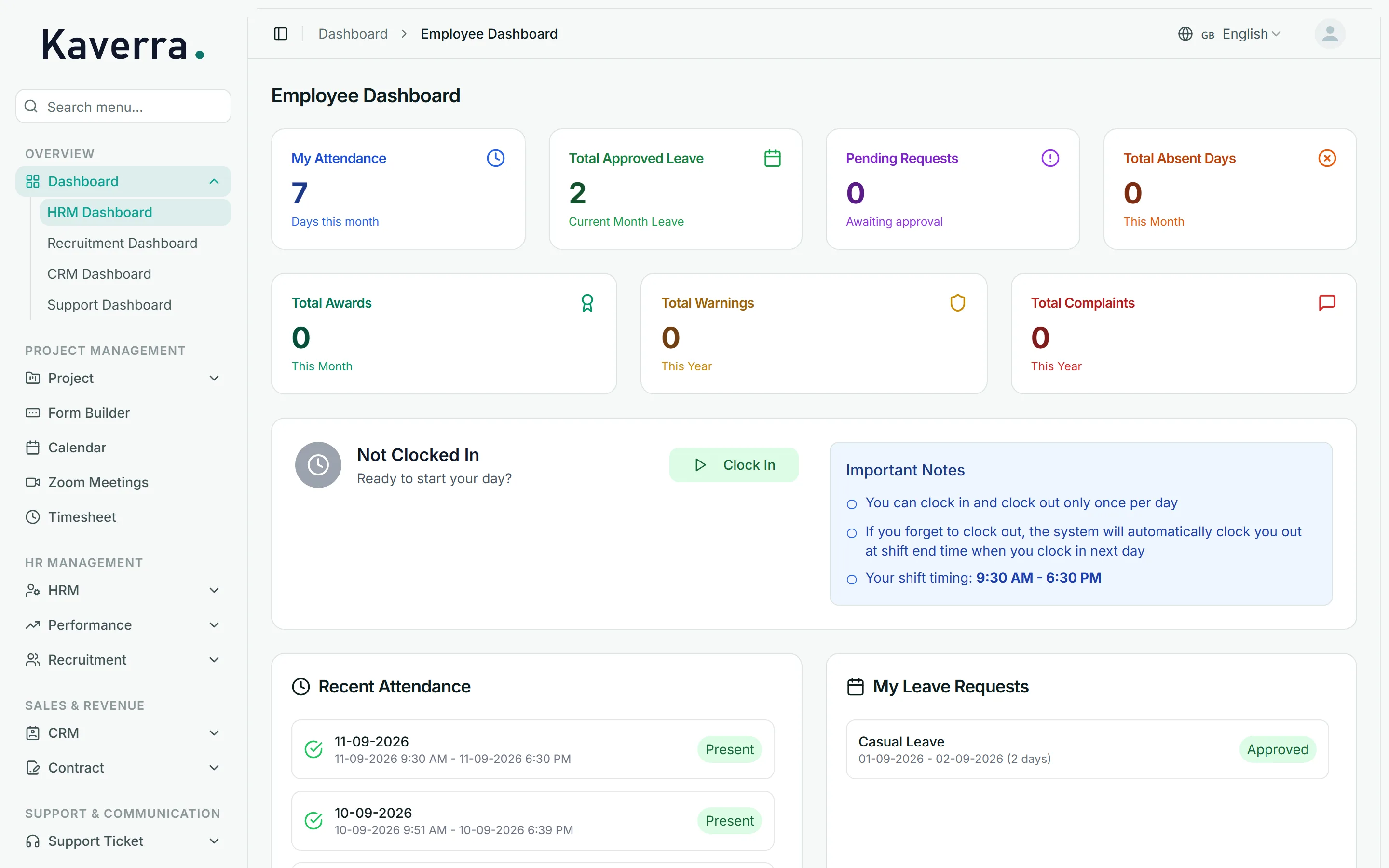
Not concept art — these are the working surfaces: raising a compliant invoice, watching the return build itself, running payroll that lands in the ledger. Everything below exists in the product today.
Filing month
Every posted document lands in its GSTR-1 section as it happens — B2B invoice by invoice, B2CS summarised, credit notes in CDNR. On filing day your accountant downloads the CSVs; nothing is reconstructed from memory.
Payday
Attendance and leave feed the run; the run posts to the ledger the moment it's approved. The salary expense your P&L shows and the payroll your HR ran are the same number, because they are the same record.
And underneath it all
The dashboard, the POS counter, the payroll run and the GST return are views over the same double-entry journal — which is why the numbers can't drift apart. Every screen on this page writes to it; that ledger is the product.
Company
Kaverra exists because of two habits we kept meeting in business software: charging per person for tools a whole company needs, and treating GST as a report bolted on at month-end instead of a property of every document.
Per-organisation pricing is fairer than per-seat. When software charges by the head, growing teams get punished for hiring, and the workaround — shared logins — quietly destroys the audit trail. We price by the company, in bands, so the tenth person costs nothing and every action still has a name on it.
The ledger is the product. Everything else — invoicing, POS, payroll, projects — is a way of writing to it. If debits don't equal credits, nothing else we ship matters. That's why our returns screen names what it couldn't classify, and why our dashboard reads the same journals your accountant will.
Limits are disclosed, not discovered. We publish what we don't do — e-invoicing, e-way bills, portal filing — on the pages where you'd decide to buy. A limitation disclosed is a scoping conversation; the same one found in month two is a refund conversation. We prefer the first kind.
A backup that has never been restored is a hypothesis. We rehearse ours and publish the number: 14 seconds to restore the database, verified against a row-by-row manifest and a trial balance that has to tie. Your data also lives in India — the application and its backups are hosted in Mumbai.
The failure mode of business software is claiming to have worked. Every design decision in Kaverra — the amber panel, the tied trial balance, the published restore time — exists so the system proves itself instead of asking to be believed.
The free plan is the honest test — your data, no card, no time limit.
Contact
One address reaches us for sales, support and everything else. We reply within one business day, IST — usually much faster.
Sales questions, support, billing, security disclosures — everything starts here. Replies within one business day, IST.
Writing about a problem? Include your company name, the screen you were on, and what you expected to happen — that usually turns two emails into one.
Evaluating for a client as a CA or consultant? Say so — we'll set up a sandbox with realistic data instead of an empty trial.
The pricing page answers plan and billing questions, the GST page lists exactly what is and isn't built, and the security page covers backups and data isolation. If the answer should have been on one of those pages and wasn't — tell us that too.
Legal
These terms govern your use of Kaverra, a business management platform provided as a subscription service ("the Service"). By creating an account or using the Service you agree to them on behalf of yourself and the organisation you represent.
Each person using the Service must have their own login. You are responsible for the actions taken under your organisation's accounts and for keeping credentials confidential. Plans include a stated number of users; adding people beyond the band requires moving to a plan that carries them.
Paid plans include a trial as stated on the pricing page. The free plan is free indefinitely within its limits. We may adjust what future trials or free plans include; changes do not remove data you have already entered.
Everything you enter into the Service belongs to your organisation. We process it only to operate the Service, as described in the Privacy Policy. You can request an export of your data at any time while your account is active or within the retention window after lapse.
When a plan expires or is cancelled, access to modules stops but your data is not deleted. We retain it for at least 90 days after lapse, during which renewing restores access and you may request an export. After the retention window we may delete it.
You may not use the Service to break the law, to store or distribute malicious code, to attempt access to another organisation's data, or to resell the Service without a written agreement with us. We may suspend accounts that endanger the platform or other customers, and will tell you why.
The Service produces GST computations, documents and return-ready exports from the data you enter. It does not file returns, and its output is not professional tax advice. A qualified professional should review and file your returns; you remain responsible for the accuracy of the data you enter and for your statutory compliance.
We work to keep the Service available at all times but do not guarantee uninterrupted operation. Planned maintenance is done outside Indian business hours where possible. We improve the Service continuously; where a change removes something material, we tell affected customers ahead of time.
To the fullest extent permitted by law, our total liability arising out of or relating to the Service is limited to the amount you paid us in the twelve months preceding the claim. We are not liable for indirect or consequential losses, or for losses arising from data you chose not to let us back up.
These terms are governed by the laws of India. Disputes are subject to the exclusive jurisdiction of the courts at our registered office.
We may update these terms; the date above always reflects the current version. Material changes are announced inside the Service before they take effect. Continued use after a change takes effect is acceptance of it.
Legal
We use your data to operate the Service: rendering your screens, computing your figures, sending the emails you trigger (invoices, password resets, notifications), and keeping backups. We do not sell data, share it with advertisers, or use your business records for anything other than serving your organisation.
The application and its database are hosted in Mumbai, India. Nightly backups are kept on the server and copied off-site; backups exist so your data survives a disaster, and they are covered by the same confidentiality as the live system.
Within your organisation, access follows the roles and permissions you configure. Across organisations, data is separated by company scoping enforced in the data layer — one customer cannot see another's records. Our operators access customer data only to provide support you've asked for or to keep the Service running.
The application uses session cookies to keep you signed in. This website sets no third-party trackers and runs no advertising or analytics scripts.
Active accounts keep their data for as long as they subscribe. After a subscription lapses we retain data for at least 90 days so a renewal can restore it, then may delete it. You can request an export at any time, and deletion of your organisation's data once any legal retention obligations (such as tax records) allow.
Transactional email — invoices, password resets, notifications — is sent because you or your organisation triggered it. We do not send marketing email to your customers, and we keep our own product announcements infrequent.
Write to support@kaverra.in for anything in this policy, including export and deletion requests.
Legal
Every paid plan includes a free trial, and the free plan has no time limit — so you can test Kaverra with your own data before any money changes hands. We'd rather you buy confident than refund disappointed.
If Kaverra isn't right for you, tell us within 14 days of your first paid subscription and we'll refund it in full. No forms, no argument — one email to support@kaverra.in from your account's email address.
Refunds go back to the original payment method through Razorpay, normally within 5–7 business days of approval. GST charged on a refunded amount is refunded with it, and a credit note is issued against the original tax invoice.
A refund ends the subscription it paid for. Your data then follows the lapse rules in the Terms of Service — kept for at least 90 days, exportable on request.